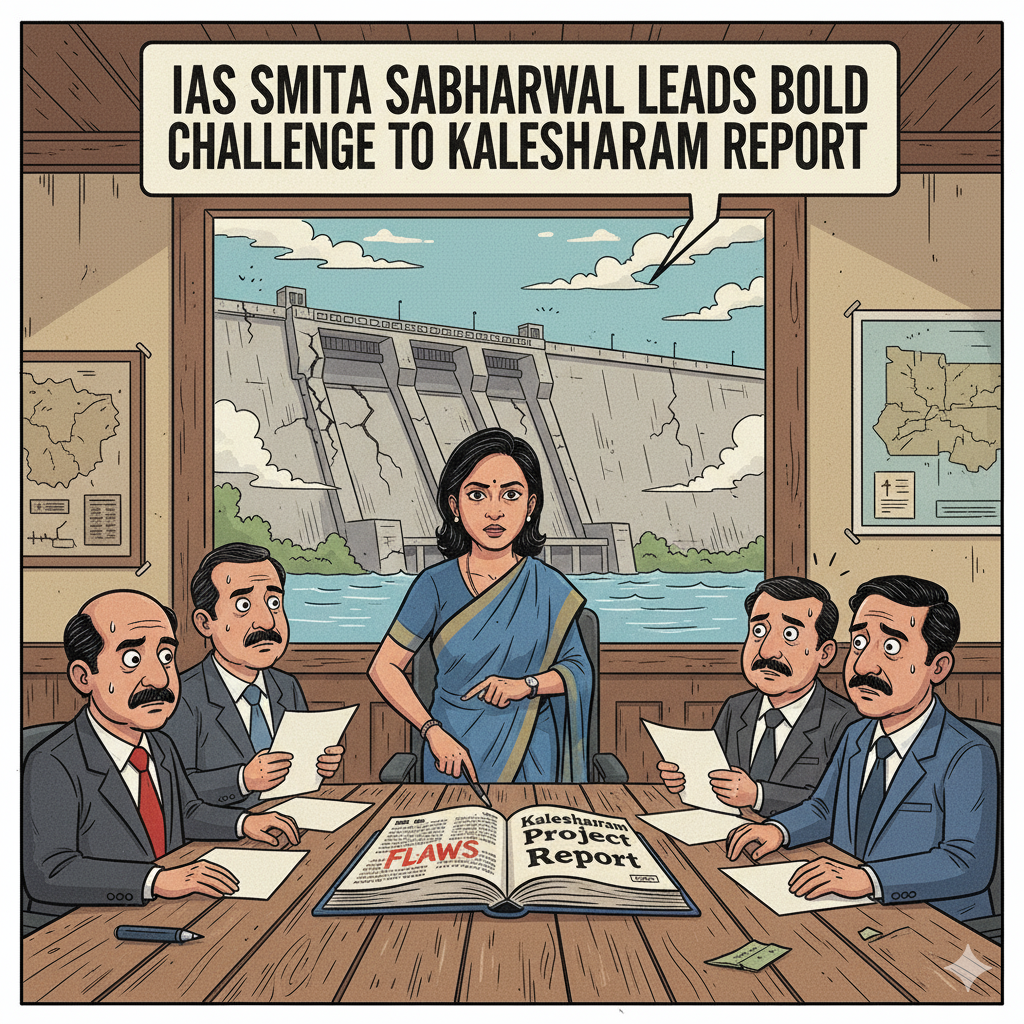
In a powerful display of integrity and leadership, IAS Smita Sabharwal Leads Bold Challenge to Kaleshwaram Report, taking a stand that has drawn national attention. Known as the “People’s Officer,” Smita Sabharwal, an accomplished Indian Administrative Service (IAS) officer of the Telangana cadre, has filed a petition in the Telangana High Court questioning key findings and recommendations of the Kaleshwaram Lift Irrigation Project (KLIP) commission report.
This decisive move, where IAS Smita Sabharwal Leads Bold Challenge to Kaleshwaram Report, signals a turning point in the demand for transparency and good governance in India’s public infrastructure projects. Citizens, policy experts, and activists alike see it as a rare yet inspiring act of courage in an environment where bureaucrats are often expected to remain silent.
Why the Kaleshwaram Project Matters
The Kaleshwaram Lift Irrigation Project, once touted as the world’s largest multi-stage lift irrigation system, was designed to transform Telangana’s agrarian landscape by irrigating over 18 lakh acres of farmland and providing drinking water to major cities. However, over the years, the project has faced intense scrutiny for cost escalations, technical irregularities, and delays in execution.
When the commission’s report was released, it pointed to financial mismanagement and possible lapses in structural design. But some sections of the report were criticized for what many believed to be sweeping conclusions and unverified allegations against certain officers. It was here that IAS Smita Sabharwal Leads Bold Challenge to Kaleshwaram Report, asserting that the findings must be evidence-based and factually accurate.
Smita Sabharwal’s Stand for Due Process
Known for her impeccable service record, IAS Smita Sabharwal Leads Bold Challenge to Kaleshwaram Report not to undermine accountability but to strengthen it. In her petition, she reportedly raised concerns about procedural lapses in the commission’s review and questioned whether due process was followed before naming individuals.
Legal experts note that by challenging the report, Smita is not shielding wrongdoing but seeking fairness. Her argument emphasizes that public reports, especially those impacting reputations and careers, must rely on verifiable evidence and maintain objectivity. This balanced approach is why IAS Smita Sabharwal Leads Bold Challenge to Kaleshwaram Report resonates with many professionals who value ethical governance.
A Bureaucrat Breaking the Silence
Typically, senior IAS officers avoid publicly disputing government reports. However, IAS Smita Sabharwal Leads Bold Challenge to Kaleshwaram Report and breaks that norm. Over her two-decade career, she has worked in crucial positions — including roles in the Chief Minister’s Office and developmental assignments across Telangana and Andhra Pradesh — earning respect for efficient, citizen-first administration.
Her track record includes successful digital governance initiatives, urban planning breakthroughs, and empowerment projects for women and farmers. By questioning the report’s accuracy, she upholds the principle that integrity is non-negotiable — even if it means standing alone.
Ripple Effect on Governance and Public Trust
The moment IAS Smita Sabharwal Leads Bold Challenge to Kaleshwaram Report, it sparked widespread debate. Political commentators say it sends a clear message — that bureaucrats can and should seek redress if maligned unfairly.
For the public, this move reinforces trust that some officials still put honesty and accountability first. Social media has seen trending support, with hashtags celebrating her courage. Civil society groups argue that if more officers follow this example, systemic transparency will improve.
Importantly, this case could set a legal precedent for how inquiry commissions operate. Courts may now look more closely at the fairness and evidentiary standards applied in investigative reports. This is why experts believe the moment IAS Smita Sabharwal Leads Bold Challenge to Kaleshwaram Report will be studied for years to come.
Legal Perspective on the Case
From a legal standpoint, challenging a commission report in the High Court is a structured way to demand fairness. When IAS Smita Sabharwal Leads Bold Challenge to Kaleshwaram Report, she invokes the right to protect professional dignity while supporting lawful investigation.
Lawyers highlight that the judiciary has, in the past, intervened when reports or inquiries were found biased or procedurally flawed. This case could push for clearer guidelines on transparency, evidence handling, and rights of individuals named in public reports.
Media and Public Reaction
Unsurprisingly, the move where IAS Smita Sabharwal Leads Bold Challenge to Kaleshwaram Report has dominated headlines. Mainstream news channels, digital outlets, and regional media are closely following the court proceedings. While some political voices have attempted to frame it as resistance to scrutiny, public opinion is largely in her favor.
Social media conversations praise her as a role model for standing up for professional dignity while still supporting the fight against corruption. Young aspirants preparing for the UPSC exams are especially inspired, seeing in her action a message that ethics and courage define true leadership.
What This Means for Future Projects
The decision where IAS Smita Sabharwal Leads Bold Challenge to Kaleshwaram Report could influence future large-scale infrastructure reviews. If the judiciary emphasizes evidence-based findings, future commissions might adopt stricter investigative protocols, ensuring fairness and factual accuracy.
This, in turn, could help India avoid costly controversies, protect honest officers, and encourage whistleblowers to expose wrongdoing without fear of indiscriminate blame.
Leadership Lessons for India’s Bureaucracy
- Integrity matters more than convenience: The fact that IAS Smita Sabharwal Leads Bold Challenge to Kaleshwaram Report shows professionals can question injustice while respecting institutional frameworks.
- Courage inspires systemic change: Her action is already motivating young officers and civil service aspirants.
- Transparency builds trust: Calling for fairness doesn’t weaken anti-corruption efforts; it strengthens them.
Conclusion
By taking the courageous step where IAS Smita Sabharwal Leads Bold Challenge to Kaleshwaram Report, Smita Sabharwal has set an extraordinary example of ethical public service. Her action transcends individual defense — it is a call for accountability with fairness, a principle vital to India’s democratic and administrative systems.
As the High Court takes up the matter, the outcome could reshape how inquiry reports are written and reviewed. Whether or not the report is altered, one thing is certain: this moment will inspire generations of civil servants to stand for truth, dignity, and justice.