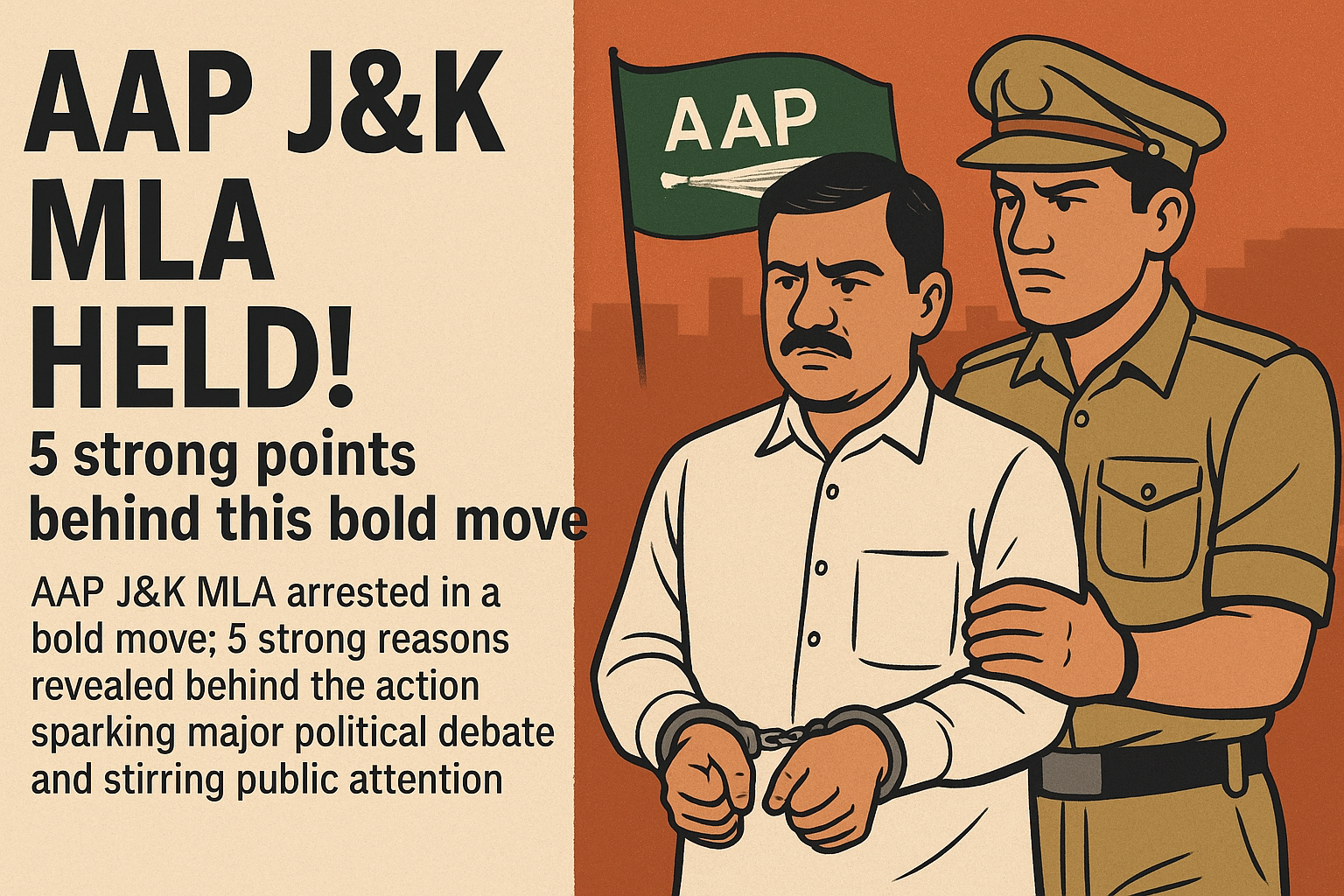
The political landscape in Jammu and Kashmir has once again been shaken after the arrest of the AAP (Aam Aadmi Party) MLA under the Public Safety Act (PSA). The move has sparked widespread debate across political lines. Opposition parties have labeled the action as “undemocratic,” while the BJP has praised the government’s decision, citing law and order concerns. In this context, it’s crucial to understand why the AAP J&K MLA Held! 5 Strong Points Behind This Bold Move matter—not just as a political event but as a statement on governance, security, and public order.
What Happened?
The arrest took place after repeated complaints and allegations against the MLA regarding activities deemed threatening to peace and public safety. Authorities invoked the PSA, a law allowing preventive detention without formal charges in cases where the individual’s actions are believed to disrupt order or threaten security.
The action has provoked a polarized response. Critics argue that it is a misuse of power, while supporters see it as a necessary step to uphold the rule of law. The debate reflects larger concerns about balancing democratic rights and public safety in sensitive regions like Jammu and Kashmir.
Why This Arrest is Being Called a Bold Move
The AAP J&K MLA Held! 5 Strong Points Behind This Bold Move help explain why this arrest is not just a political act but a carefully considered response by law enforcement and the government.
✅ 1. Protection of Public Order and Security
Jammu and Kashmir remains a region sensitive to disturbances, insurgency, and political unrest. Authorities believe that unchecked activities by influential figures can exacerbate tensions and incite violence.
The PSA was invoked as a preventive measure to ensure that public order is maintained, especially in volatile areas. By acting decisively, the administration aims to protect citizens and prevent escalation, reinforcing its commitment to peace.
This is one of the strongest reasons highlighted in the AAP J&K MLA Held! 5 Strong Points Behind This Bold Move, as the safety of the public remains a top priority.
✅ 2. Repeated Offenses and Escalating Threats
The arrested MLA had been under scrutiny for months due to alleged involvement in activities that were seen as fueling unrest. Reports pointed to multiple complaints by local authorities and intelligence agencies.
Despite warnings, there was little change in behavior. The government’s decision to invoke the PSA sends a message that repeat offenses cannot be tolerated, no matter the individual’s political affiliation.
This step reinforces that actions—not positions or titles—are what determine accountability.
✅ 3. A Strong Signal Against Political Shielding
One of the concerns often raised is that political connections shield influential figures from scrutiny. By arresting an MLA from a prominent party, the administration is signaling that no one is above the law.
The AAP J&K MLA Held! 5 Strong Points Behind This Bold Move clearly underline that governance must transcend partisan politics. When security concerns arise, decisive intervention is necessary regardless of the political weight the individual carries.
This approach strengthens the credibility of institutions and helps maintain trust in the justice system.
✅ 4. Encouraging Law-Abiding Governance
In times of political turmoil, setting a precedent of strict adherence to the law plays a critical role in deterring future misconduct. The move highlights that governance must prioritize legal procedures over partisan interests.
By acting firmly, authorities aim to restore faith among citizens that the system works impartially. This not only curbs potential law-breaking but also empowers honest leaders and citizens who value peace and stability.
This is a vital point within the AAP J&K MLA Held! 5 Strong Points Behind This Bold Move, as it reinforces a culture where law is respected over politics.
✅ 5. Addressing Regional Instability
Jammu and Kashmir’s unique political and social fabric demands careful management of tensions. Preventive actions are essential to avoid unrest that could spiral into larger conflicts, affecting not just the local population but national security.
The PSA was designed to allow authorities to step in before situations worsen. The arrest reflects this approach—intervening early to prevent escalation rather than waiting for damage to occur.
This proactive method is one of the most significant reasons why this arrest is being viewed as bold and necessary.
Reactions from Political Parties
The aftermath of the arrest has sparked reactions across the political spectrum.
Opposition’s View: “Undemocratic Action”
Several opposition leaders have expressed concern over the PSA’s use, arguing that preventive detention undermines democratic rights. They claim that such measures stifle dissent and could be used as a tool for political vendettas.
However, critics are also questioning the timing and manner of enforcement, suggesting that alternate legal routes should have been pursued before invoking PSA powers.
BJP’s Stand: “Action Against Repeat Offender”
The BJP and allied groups have welcomed the move, stating that maintaining law and order is paramount. They argue that repeat offenses and disruptive behavior warranted intervention, and the PSA was appropriately applied.
They believe that leniency toward politically connected figures would only embolden lawbreakers, and the government’s action strengthens public safety protocols.
The Bigger Picture
The AAP J&K MLA Held! 5 Strong Points Behind This Bold Move go beyond a single arrest. It reflects the challenges of governance in areas where political, social, and security concerns intersect.
Balancing Act: Rights vs. Safety
This case raises an important question: How should governments balance civil liberties with national security? Preventive detention laws, while controversial, are tools that authorities rely on when conventional methods fall short.
Democratic Responsibility
Democracy doesn’t mean impunity. Accountability applies to all citizens equally—especially those in positions of power. By acting against a sitting MLA, the government reinforces that public office is a responsibility, not a privilege.
Building Institutional Trust
Swift and impartial action builds trust in law enforcement. Citizens are more likely to cooperate with authorities when they see fairness prevail over favoritism.
Conclusion
The AAP J&K MLA Held! 5 Strong Points Behind This Bold Move shed light on why this arrest is more than a political statement—it is an effort to protect citizens, uphold law and order, and ensure accountability. The debate it has sparked is a healthy reflection of democratic discourse, but it also underscores the complexities involved in governance within sensitive regions.
For those observing the situation, it’s a reminder that public safety cannot be compromised, and political connections should never obstruct justice. Whether one supports or opposes the arrest, it is crucial to recognize the broader implications—how governance, security, and democracy must work together to create a stable and safe environment.
This arrest will likely shape future decisions, influence regional politics, and set a precedent for how preventive laws are applied in high-stakes situations. The discussion around it will continue, but one thing remains clear: decisive leadership and responsible governance are essential pillars for peace and progress.