
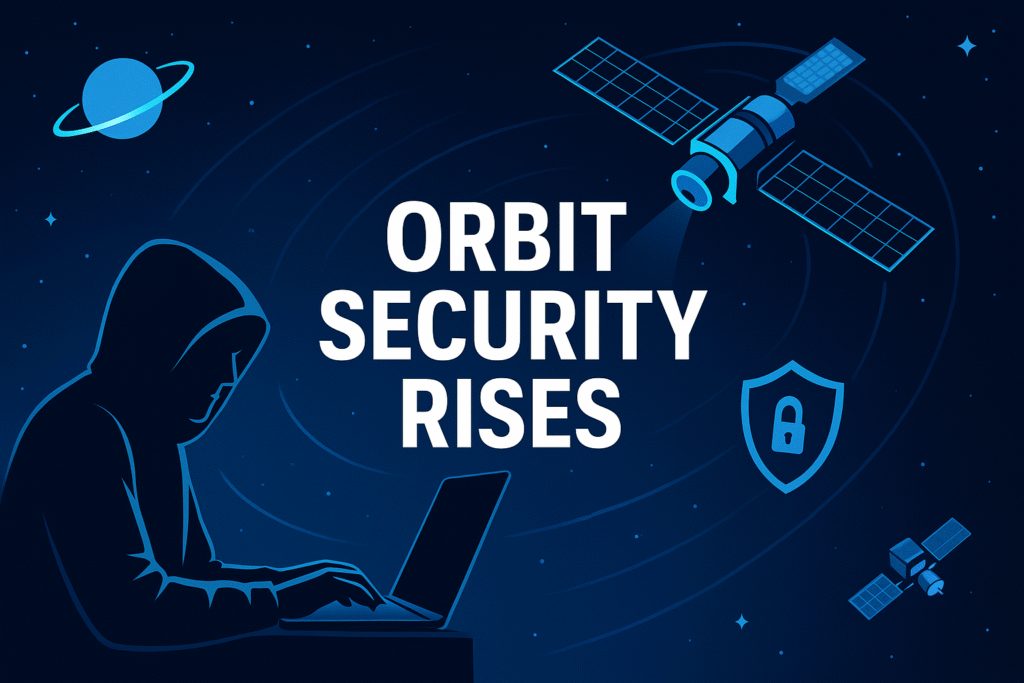
In the 21st century, global warfare has expanded beyond land, sea, and air into a new battlefield: outer space. With over 12,000 satellites orbiting Earth, space has become a critical hub for communication, navigation, intelligence, and defense. The phrase Orbit Security Rises has never been more relevant, as recent incidents highlight just how vulnerable satellites are to cyberattacks, hijacking, and even potential weapons designed to wipe them out.
A Victory Day Hack that Shook Ukraine
During Russia’s Victory Day parade, hackers aligned with the Kremlin hijacked a Ukrainian satellite. Instead of regular programming, Ukrainian citizens were shown Moscow’s military parade: tanks, soldiers, and heavy weaponry. The act was a chilling reminder that Orbit Security Rises as a defining issue of modern warfare.
This wasn’t merely about propaganda; it demonstrated that disrupting a satellite could devastate a nation without a single bullet being fired. By targeting a satellite’s software or interfering with its signals, hackers can cripple communication systems, military operations, or even global navigation networks like GPS.
As Tom Pace, CEO of cybersecurity firm NetRise, noted: “If you can impede a satellite’s ability to communicate, you can cause a significant disruption. Imagine if a population lost GPS and the confusion it would cause.” Indeed, Orbit Security Rises as a matter of national and global concern.
Satellites: The Weak Link in Global Security
Today’s satellites are central to daily life—supporting television broadcasts, weather forecasts, financial transactions, and military operations. But they are also a prime target for adversaries. Hackers typically exploit the weakest links, such as outdated software or unprotected ground systems, rather than the highly secure orbiting devices themselves.
For example, during Russia’s 2022 invasion of Ukraine, the U.S.-based satellite company Viasat was attacked with malware, disrupting tens of thousands of modems and causing massive outages across Europe. The attack revealed the fragility of orbiting infrastructure and underscored why Orbit Security Rises in priority for governments and corporations alike.
The Threat of Space Weapons
Perhaps more alarming is the development of space-based weapons. U.S. officials have raised concerns that Russia is working on a nuclear anti-satellite weapon capable of destroying entire swaths of low-Earth orbit. Such a weapon would not only disable satellites but could make entire orbital regions unusable for years due to cascading debris and radiation damage.
“If this anti-satellite nuclear weapon would be put in space, it would be the end of the space age,” said one defense analyst. “This is the Cuban Missile Crisis in space.” Once again, Orbit Security Rises as the world faces challenges that extend far beyond Earth’s atmosphere.
Space as the Next Resource Race
Beyond military concerns, nations are racing to exploit extraterrestrial resources. The moon and asteroids are rich in valuable minerals, including helium-3, which scientists believe could fuel nuclear fusion and generate limitless clean energy. The U.S., China, and Russia are all vying for dominance in this arena.
NASA recently announced plans to send a small nuclear reactor to the moon, emphasizing the urgency of arriving before rivals. Acting NASA Administrator Sean Duffy stated: “We’re in a race to the moon. To have a base there, we need energy. We want to get there first and claim that for America.”
This highlights another dimension in which Orbit Security Rises—control over lunar resources may determine the geopolitical balance of power for decades to come.
The Economic and Military Stakes
Satellites don’t just provide convenience; they underpin global economies. Supply chains, trade routes, stock markets, and critical infrastructure all rely on satellite data. Similarly, militaries use satellites for early-warning missile detection, secure communications, and battlefield intelligence.
A successful cyberattack or orbital strike could destabilize not only a nation’s defense but also its economy. With such high stakes, Orbit Security Rises to the forefront of international strategy.
Challenges in Cybersecurity
Protecting orbiting satellites is as much a cybersecurity issue as it is a military one. Outdated systems, insecure coding practices, and vulnerable ground stations open the door for attackers. Unlike conventional warfare, a single cyber intrusion can cause global consequences.
Joseph Rooke, a cybersecurity expert with defense industry experience, noted: “This isn’t sci-fi. It’s quickly becoming reality. If you dominate Earth’s energy needs and control orbit, that’s game over.” His words reinforce that Orbit Security Rises not only as a defense challenge but also as an economic and technological imperative.
A Cold War 2.0 in Space
The end of the original Cold War slowed space militarization, but with new technologies and competition for lunar mining, the race has reignited. Just as Sputnik launched the space age in 1957, today’s threats may mark the beginning of a new era of conflict and competition.
The U.S., China, and Russia are already investing billions in space-based defense systems, satellite constellations, and moon colonization projects. This new rivalry shows exactly why Orbit Security Rises as one of the most pressing challenges of our time.
Building a Secure Space Future
To secure the orbital domain, experts argue for stronger international agreements, advanced encryption for satellites, and public-private partnerships to ensure resilience. Cybersecurity must be treated as a critical defense priority, with constant monitoring, software updates, and redundancy built into satellite networks.
Moreover, the development of defensive technologies—such as satellite shields, anti-jamming tools, and AI-driven threat detection—will be vital in ensuring that Orbit Security Rises as a protective barrier rather than a looming threat.
Conclusion: Orbit Security Rises as Humanity’s Next Challenge
From Russia’s hacking of Ukrainian satellites to fears of nuclear space weapons, the evidence is clear: Orbit Security Rises as one of the defining issues of the 21st century. Satellites are no longer silent orbiters; they are essential nodes in the global economy, national defense, and scientific advancement.
As nations prepare for lunar mining, nuclear-powered bases, and deeper exploration into the cosmos, the importance of safeguarding orbit cannot be overstated. Whether through cyber defense, diplomatic agreements, or advanced technology, the world must prioritize space protection.
The phrase Orbit Security Rises is not just a headline—it is a call to action. Humanity’s future in space depends on the steps we take today to secure the final frontier.